
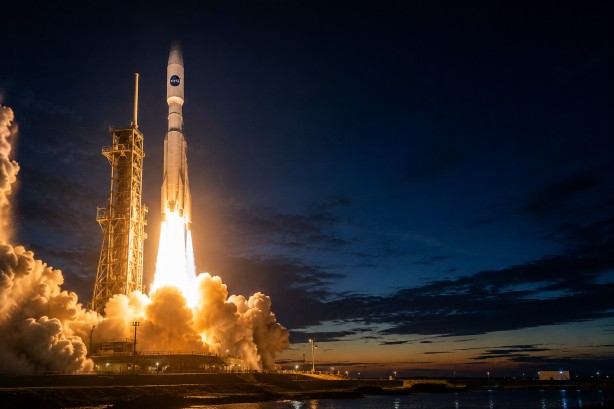
The Nancy Grace Roman Space Telescope has embarked on its mission from Florida, aiming for a destination nearly one million miles from Earth. This $4.3 billion project, born out of nearly a decade of meticulous planning and development, seeks to delve into the mysteries of the universe by exploring exoplanets, the formation of planets and galaxies, and more. The telescope’s journey commenced with a successful launch from NASA’s Kennedy Space Center, utilizing a SpaceX Falcon Heavy rocket, marking a significant milestone for the mission.
Unlike its predecessors, the Hubble and James Webb Space Telescopes, the Roman is designed as a complement rather than a replacement. A standout feature of the Roman Telescope is its 300-megapixel infrared camera, which promises to deliver images with Hubble-like resolution but with a field of view more than 100 times larger. This capability means each captured image will cover a portion of the sky approximately 1.5 times the apparent size of the full Moon.
Among Roman’s suite of instruments is a sophisticated coronagraph, engineered to block the overwhelming brightness of stars. This technology is expected to enable scientists to observe planets orbiting these stars with unprecedented clarity. The telescope’s observations could lead to the discovery of previously unseen worlds, including older and colder planets situated in relatively close orbits around their stars.
Roman’s destination is the Sun-Earth Lagrange Point 2, a stable point in space which also serves as the location for the James Webb Space Telescope. From this vantage point, Roman will embark on a diverse array of observations throughout its planned five-year primary mission, with the possibility of extension. Researchers anticipate that Roman will shed light on many cosmic phenomena, including dark matter, dark energy, distant galaxies, supernovae, black holes, and exoplanets. The vast scope of Roman’s observations could also pinpoint targets for more detailed investigations by Hubble and Webb.
The scientific community eagerly awaits Roman’s first images, projected to be released in early 2027 after extensive testing and calibration phases. NASA intends to make the images publicly accessible, offering both professional researchers and amateur astronomers a wealth of new data. The successful launch marks a triumph over previous budgetary challenges, as the mission once faced cancellation threats from proposed cuts to NASA’s science funding. Thanks to congressional support, Roman stands as a testament to NASA’s ongoing quest to unravel the mysteries of cosmic evolution and planetary formation across billions of years.