
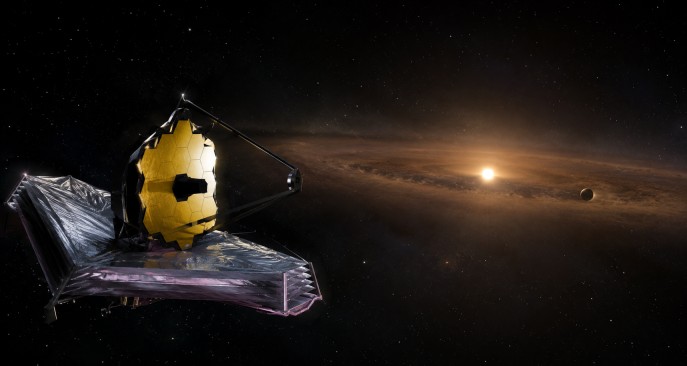
In a remarkable astronomical discovery, researchers have identified a new exoplanet, Beta Pictoris d, positioned in orbit around the nearby star Beta Pictoris. This finding, accomplished with the help of NASA’s James Webb Space Telescope, adds a third giant planet to the already extensively studied planetary system.
Unlike its planetary neighbors, Beta Pictoris d was not captured through direct imaging techniques. Instead, astronomers uncovered its presence by detecting the distinct chemical signature of its atmosphere. This breakthrough occurred unexpectedly as scientists were utilizing the telescope’s Near-Infrared Spectrograph (NIRSpec) to examine another planet within the same system.
The confirmation of Beta Pictoris d’s existence came through detailed analysis of its atmospheric composition and movement, pinpointing elements such as carbon monoxide, water vapor, and methane. These observations revealed that the planet is a massive entity, residing within the system’s luminous debris disk, which had previously obscured it from traditional imaging methods.
The Beta Pictoris system, situated approximately 63 light-years from Earth, is about 23 million years old. It serves as a crucial research site for understanding the formation and evolution of planetary systems. Beta Pictoris d is believed to be at least twice the mass of Jupiter and orbits its host star at a distance similar to that of Neptune in our solar system.
This discovery represents the first instance of an exoplanet being identified primarily through moderate-resolution spectroscopy, showcasing a novel approach for detecting planets hidden within dusty celestial environments. Researchers suggest that this technique could greatly enhance future exploration efforts for exoplanets throughout the Milky Way.