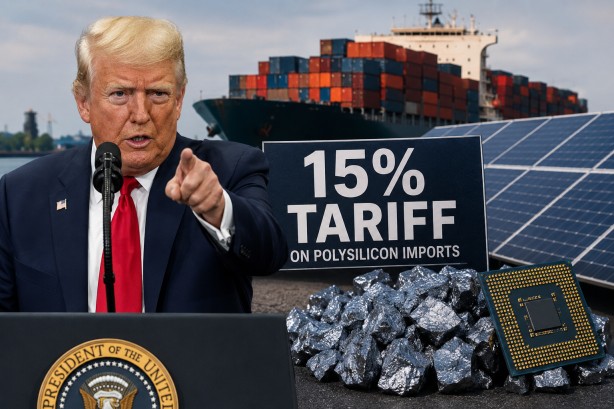
In a move aimed at bolstering domestic industry and reducing dependence on China, US President Donald Trump has announced a 15% tariff on imported products made with polysilicon, a vital material in the production of semiconductors and solar panels. These tariffs, set to be implemented on December 4, are part of a broader strategy to enhance national economic and security interests by reinforcing key supply chains.
Polysilicon, an extremely pure form of silicon, is crucial for manufacturing semiconductors that drive artificial intelligence systems and data centers, as well as solar cells and panels. Currently, China stands as the world’s foremost producer of this material, which has prompted the US administration to act to protect and promote its domestic manufacturing capabilities.
Under the new regulations, minimum import prices have been established: $21 per kilogram for polysilicon, $100 per kilogram for polysilicon ingots and wafers, $0.22 per watt for solar cells, and $0.38 per watt for solar modules and panels. These measures are designed to support the viability of American polysilicon production facilities and encourage investment in this sector.
China has expressed disapproval of these tariffs, accusing the US of leveraging national security as a pretext to impose restrictions on Chinese businesses. They warn that such protectionism could lead to disruptions in trade relations between the two nations. Meanwhile, the US has two significant polysilicon manufacturing plants, operated by Hemlock Semiconductor in Michigan and Wacker Chemie in Tennessee, which could benefit from these protective measures.
Additionally, the policy allows for the possibility of government incentives for companies that invest in domestic polysilicon and related manufacturing. This initiative comes at a time when China’s exports, particularly in electronics and artificial intelligence-related products, continue to witness substantial growth, highlighting the competitive pressures faced by US industries.