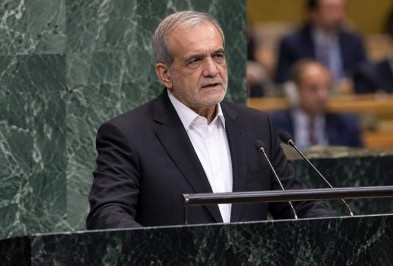
Tensions between the United States and Iran continue to simmer as Iranian President Masoud Pezeshkian addressed the United Nations General Assembly, criticizing U.S. President Donald Trump while expressing Iran’s willingness to engage in dialogue. This comes amid heightened geopolitical friction and economic pressures affecting the region, notably in the strategic Strait of Hormuz.
During his speech, Pezeshkian emphasized Iran’s readiness for diplomacy but firmly rejected any negotiations conducted under threats or military pressure. His comments followed Trump’s assertion at the UN that the U.S. was considering further actions against Iran, despite the potential for renewed discussions.
Adding a diplomatic layer to the complexities, Iranian Foreign Minister Abbas Araghchi and U.S. special envoy Steve Witkoff met on the sidelines of the UN General Assembly. The meeting, mediated by Qatar, focused on Iran’s conditions for de-escalating tensions and alleviating economic strain. Key issues include the lifting of sanctions, ending hostilities, and reopening the Strait of Hormuz, a critical passage for global energy supplies.
Pezeshkian reiterated that Iran seeks a peaceful nuclear program and urged regional cooperation on security over reliance on external powers. However, he accused the U.S. and Israel of aggression, defending Iran’s actions as self-defense amid increasing economic sanctions and restricted oil exports.
Despite these challenges, the latest diplomatic engagements suggest that dialogue remains a possibility. The discussions highlight ongoing disputes over sanctions, military pressure, and Iran’s nuclear ambitions, underscoring the fragile nature of peace efforts in the region.